Parsing Mono
Roadmap
This is the hardest part of this whole guide. Get ready for a long and tedious process. Here is a roadmap:
- Get the pointer to mono root domain
- Parse MonoDomain struct and get domain_assemblies filed
- Parse MonoAssembly struct and get image filed
- Parse MonoImage struct and get MonoInternalHashTable field
- Parse MonoInternalHashTable struct and get table field
- Parse MonoClassDef
- Parse MonoClassField
By the end of this page you should have definition for all classes of the game. Mono works in such way that the runtime always have the full information about all objects. That's why mono is so "easy" to parse
Parsing the instruction
In the pervious part we got the mono_get_root_domain function that returns a pointer
mono_get_root_domain (void)
{
  return mono_root_domain;
}
When reading the next 8 bytes and disassembling them we get this:
# 0: 48 8b 05 fc 11 44 00   mov rax, qword ptr [rip + 0x4411fc]
# 7: c3                     ret
Then we extract the offset from the instruction fc 11 44 00
relativeOffset is 0x4411fc (note that it is backwards because of the little endian)
This is a relative offset and the instruction is 7 bytes long, so
mono_root_domain is mono_get_root_domain + 7 + relativeOffset
This is the only instruction we will ever disassemble. The rest of this project is just reading C structs.
Go to mono_root_domain
MonoDomain
You are looking at _MonoDomain struct.
By the way
Get used to reading the mono source code! I will leave all the links here so that you will know where to look at.
To keep the text compact I will not copy paste C source code but I will paste my ASCII tables for the structs.
┌────────────────────────────────────────────────────────────────────┐
│ _MonoDomain                                                        │
│ Size: ??? bytes, Alignment: 8 bytes                                │
├────────────────────────────────────────────────────────────────────┤
│   0- 47 │ MonoCoopMutex   │ lock                │ 48 bytes  │      │
│  48- 55 │ MonoAppDomain*  │ domain              │ 8 bytes   │      │
│  56- 63 │ MonoAppContext* │ default_context     │ 8 bytes   │      │
│  64- 71 │ MonoException*  │ out_of_memory_ex    │ 8 bytes   │      │
│  72- 79 │ MonoException*  │ null_reference_ex   │ 8 bytes   │      │
│  80- 87 │ MonoException*  │ stack_overflow_ex   │ 8 bytes   │      │
│  88- 95 │ MonoObject*     │ typeof_void         │ 8 bytes   │      │
│  96-103 │ MonoObject*     │ ephemeron_tombstone │ 8 bytes   │      │
│ 104-111 │ MonoArray*      │ empty_types         │ 8 bytes   │      │
│ 112-119 │ MonoString*     │ empty_string        │ 8 bytes   │      │
│ 120-127 │ MonoGHashTable* │ env                 │ 8 bytes   │      │
│ 128-135 │ MonoGHashTable* │ ldstr_table         │ 8 bytes   │      │
│ 136-139 │ guint32         │ state               │ 4 bytes   │      │
│ 140-143 │ gint32          │ domain_id           │ 4 bytes   │      │
│ 144-147 │ gint32          │ shadow_serial       │ 4 bytes   │      │
│ 148-151 │                 │ [padding]           │ 4 bytes   │      │
│ 152-159 │ GSList*         │ domain_assemblies   │ 8 bytes   │ <--  │
│ 160-167 │ MonoAssembly*   │ entry_assembly      │ 8 bytes   │      │
│ 168-175 │ char*           │ friendly_name       │ 8 bytes   │ <--  │
│ ... and other fields                                               │
└────────────────────────────────────────────────────────────────────┘
Each Mono application has its own MonoDomain. It contains Mono assemblies, static variables and heap.
Go to char* friendly_name. Read NT string. Strings are your best friends in this project. If you are reading a string and it comes out as readable text, it means that your offsets are correct and you're doing everything right
Go to GSList* domain_assemblies
GSList
You are looking at a GSList
GSList is a linked list.
 ┌────────────────────────────────────────────────────────────────────┐
 │ _GSList                                                            │
 │ Size: 16 bytes, Alignment: 8 bytes                                 │
 ├────────────────────────────────────────────────────────────────────┤
 │   0-  7 │ gpointer*       │ data    │ 8 bytes   │ <--              │
 │   8- 15 │ GSList*         │ next    │ 8 bytes   │ <--              │
 └────────────────────────────────────────────────────────────────────┘
Read gpointer* data. Save it. It is a general pointer with no way to know what it is pointing to (: cool, right? It points to an instance of _MonoAssembly
Goto GSList* next. If it is zero, you have reached the end of the list.
Repeat until you reach the end.
Goto each gpointer* data
MonoAssembly
You are looking at MonoAssembly
MonoAssembly is a in-memory representation of a .NET dll. If you open any .NET dll with dotPeek or any other decompiler you will see something like these
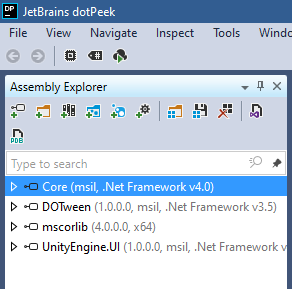
These are just 4 random assemblies from the game. Core being the most important one
Assemblies can be quite large. So instead of parsing all of them, let's first get the name of each one and only parse the one we need.
 ┌────────────────────────────────────────────────────────────────────────────────────────┐
 │ _MonoAssembly                                                                          │
 │ Size: 128 bytes, Alignment: 8 bytes                                                    │
 ├────────────────────────────────────────────────────────────────────────────────────────┤
 │   0-  3 │ gint32               │ ref_count                        │ 4 bytes   │        │
 │   4-  7 │                      │ [padding]                        │ 4 bytes   │        │
 │   8- 15 │ char*                │ basedir                          │ 8 bytes   │        │
 │  16- 95 │ MonoAssemblyName     │ aname                            │ 80 bytes  │ <--    │
 │  96-103 │ MonoImage*           │ image                            │ 8 bytes   │ <--    │
 │ 104-111 │ GSList*              │ friend_assembly_names            │ 8 bytes   │        │
 │ 112-112 │ guint8               │ friend_assembly_names_inited     │ 1 byte    │        │
 │ 113-113 │ guint8               │ in_gac                           │ 1 byte    │        │
 │ 114-114 │ guint8               │ dynamic                          │ 1 byte    │        │
 │ 115-115 │ guint8               │ corlib_internal                  │ 1 byte    │        │
 │ 116-119 │ MonoAssemblyContext  │ context                          │ 4 bytes   │        │
 │ 120-120 │ guint8               │ wrap_non_exception_throws        │ 1 byte    │        │
 │ 121-121 │ guint8               │ wrap_non_exception_throws_inited │ 1 byte    │        │
 │ 122-122 │ guint8               │ jit_optimizer_disabled           │ 1 byte    │        │
 │ 123-123 │ guint8               │ jit_optimizer_disabled_inited    │ 1 byte    │        │
 │ 124-127 │ guint32              │ flags                            │ 4 bytes   │        │
 └────────────────────────────────────────────────────────────────────────────────────────┘
 ┌────────────────────────────────────────────────────────────────────────────────────────┐
 │ MonoAssemblyName                                                                       │
 │ Size: 80 bytes, Alignment: 8 bytes                                                     │
 ├────────────────────────────────────────────────────────────────────────────────────────┤
 │   0-  7 │ char*                │ name                     │ 8 bytes   │ <--            │
 │   8- 15 │ char*                │ culture                  │ 8 bytes   │                │
 │  16- 23 │ char*                │ hash_value               │ 8 bytes   │                │
 │  24- 31 │ mono_byte*           │ public_key               │ 8 bytes   │                │
 │  32- 48 │ mono_byte            │ public_key_token         │ 17 bytes  │                │
 │  49- 51 │                      │ [padding]                │ 3 bytes   │                │
 │  52- 55 │ uint32_t             │ hash_alg                 │ 4 bytes   │                │
 │  56- 59 │ uint32_t             │ hash_len                 │ 4 bytes   │                │
 │  60- 63 │ uint32_t             │ flags                    │ 4 bytes   │                │
 │  64- 65 │ uint16_t             │ major                    │ 2 bytes   │                │
 │  66- 67 │ uint16_t             │ minor                    │ 2 bytes   │                │
 │  68- 69 │ uint16_t             │ build                    │ 2 bytes   │                │
 │  70- 71 │ uint16_t             │ revision                 │ 2 bytes   │                │
 │  72- 73 │ uint16_t             │ arch                     │ 2 bytes   │                │
 │  74- 74 │ MonoBoolean          │ without_version          │ 1 byte    │                │
 │  75- 75 │ MonoBoolean          │ without_culture          │ 1 byte    │                │
 │  76- 76 │ MonoBoolean          │ without_public_key_token │ 1 byte    │                │
 │  77- 79 │                      │ [padding]                │ 3 bytes   │                │
 └────────────────────────────────────────────────────────────────────────────────────────┘
TIP
MonoAssemblyName aname is a struct, not a pointer. It is inlined.
Goto MonoAssemblyName aname. Read a NT string.
We are only interested an assembly with a name Core.
Goto MonoImage* image
MonoImage
You are looking at MonoImage
Mono assembly is just a container for Mono image. It describes the structures of all classes and methods
 ┌───────────────────────────────────────────────────────────────────────────────────┐
 │ _MonoImage                                                                        │
 │ Size: 1272 bytes, Alignment: 8 bytes                                              │
 ├───────────────────────────────────────────────────────────────────────────────────┤
 │    0-   3 │ int                       │ ref_count              │ 4 bytes   │      │
 │    4-   7 │                           │ [padding]              │ 4 bytes   │      │
 │    8-  15 │ MonoImageStorage*         │ storage                │ 8 bytes   │      │
 │   16-  23 │ char*                     │ raw_data               │ 8 bytes   │      │
 │   24-  27 │ guint32                   │ raw_data_len           │ 4 bytes   │      │
 │   28-  28 │ guint8                    │ dynamic                │ 1 byte    │      │
 │   29-  29 │ guint8                    │ ref_only               │ 1 byte    │      │
 │   30-  30 │ guint8                    │ uncompressed_metadata  │ 1 byte    │      │
 │   31-  31 │ guint8                    │ metadata_only          │ 1 byte    │      │
 │   32-  32 │ guint8                    │ load_from_context      │ 1 byte    │      │
 │   33-  33 │ guint8                    │ checked_module_cctor   │ 1 byte    │      │
 │   34-  34 │ guint8                    │ has_module_cctor       │ 1 byte    │      │
 │   35-  35 │ guint8                    │ idx_string_wide        │ 1 byte    │      │
 │   36-  36 │ guint8                    │ idx_guid_wide          │ 1 byte    │      │
 │   37-  37 │ guint8                    │ idx_blob_wide          │ 1 byte    │      │
 │   38-  38 │ guint8                    │ core_clr_platform_code │ 1 byte    │      │
 │   39-  39 │ guint8                    │ minimal_delta          │ 1 byte    │      │
 │   40-  47 │ char*                     │ name                   │ 8 bytes   │      │
 │   48-  55 │ char*                     │ filename               │ 8 bytes   │      │
 │   56-  63 │ char*                     │ assembly_name          │ 8 bytes   │      │
 │   64-  71 │ char*                     │ module_name            │ 8 bytes   │      │
 │   72-  75 │ guint32                   │ time_date_stamp        │ 4 bytes   │      │
 │   76-  79 │                           │ [padding]              │ 4 bytes   │      │
 │   80-  87 │ char*                     │ version                │ 8 bytes   │      │
 │   88-  89 │ gint16                    │ md_version_major       │ 2 bytes   │      │
 │   90-  91 │ gint16                    │ md_version_minor       │ 2 bytes   │      │
 │   92-  95 │                           │ [padding]              │ 4 bytes   │      │
 │   96- 103 │ char*                     │ guid                   │ 8 bytes   │      │
 │  104- 111 │ MonoCLIImageInfo*         │ image_info             │ 8 bytes   │      │
 │  112- 119 │ MonoMemPool*              │ mempool                │ 8 bytes   │      │
 │  120- 127 │ char*                     │ raw_metadata           │ 8 bytes   │      │
 │  128- 143 │ MonoStreamHeader          │ heap_strings           │ 16 bytes  │      │
 │  144- 159 │ MonoStreamHeader          │ heap_us                │ 16 bytes  │      │
 │  160- 175 │ MonoStreamHeader          │ heap_blob              │ 16 bytes  │      │
 │  176- 191 │ MonoStreamHeader          │ heap_guid              │ 16 bytes  │      │
 │  192- 207 │ MonoStreamHeader          │ heap_tables            │ 16 bytes  │      │
 │  208- 223 │ MonoStreamHeader          │ heap_pdb               │ 16 bytes  │      │
 │  224- 231 │ char*                     │ tables_base            │ 8 bytes   │      │
 │  232- 239 │ guint64                   │ referenced_tables      │ 8 bytes   │      │
 │  240- 247 │ int*                      │ referenced_table_rows  │ 8 bytes   │      │
 │  248-1127 │ MonoTableInfo             │ tables                 │ 880 bytes │      │
 │ 1128-1135 │ MonoAssembly**            │ references             │ 8 bytes   │      │
 │ 1136-1139 │ int                       │ nreferences            │ 4 bytes   │      │
 │ 1140-1143 │                           │ [padding]              │ 4 bytes   │      │
 │ 1144-1151 │ MonoImage**               │ modules                │ 8 bytes   │      │
 │ 1152-1155 │ guint32                   │ module_count           │ 4 bytes   │      │
 │ 1156-1159 │                           │ [padding]              │ 4 bytes   │      │
 │ 1160-1167 │ gboolean*                 │ modules_loaded         │ 8 bytes   │      │
 │ 1168-1175 │ MonoImage**               │ files                  │ 8 bytes   │      │
 │ 1176-1179 │ guint32                   │ file_count             │ 4 bytes   │      │
 │ 1180-1183 │                           │ [padding]              │ 4 bytes   │      │
 │ 1184-1191 │ MonoAotModule*            │ aot_module             │ 8 bytes   │      │
 │ 1192-1207 │ guint8                    │ aotid                  │ 16 bytes  │      │
 │ 1208-1215 │ MonoAssembly*             │ assembly               │ 8 bytes   │      │
 │ 1216-1223 │ MonoAssemblyLoadContext*  │ alc                    │ 8 bytes   │      │
 │ 1224-1231 │ GHashTable*               │ method_cache           │ 8 bytes   │      │
 │ 1232-1271 │ MonoInternalHashTable     │ class_cache            │ 40 bytes  │ <--  │
 │ ... and other fields                                                              │
 └───────────────────────────────────────────────────────────────────────────────────┘
 ┌───────────────────────────────────────────────────────────────────────────────────┐
 │ _MonoInternalHashTable                                                            │
 │ Size: 40 bytes, Alignment: 8 bytes                                                │
 ├───────────────────────────────────────────────────────────────────────────────────┤
 │    0-   7 │ GHashFunc*                      │ hash_func   │ 8 bytes   │           │
 │    8-  15 │ MonoInternalHashKeyExtractFunc* │ key_extract │ 8 bytes   │           │
 │   16-  23 │ MonoInternalHashNextValueFunc*  │ next_value  │ 8 bytes   │           │
 │   24-  27 │ gint                            │ size        │ 4 bytes   │ <--       │
 │   28-  31 │ gint                            │ num_entries │ 4 bytes   │ <--       │
 │   32-  39 │ gpointer*                       │ table       │ 8 bytes   │ <--       │
 └───────────────────────────────────────────────────────────────────────────────────┘
We are interested in MonoInternalHashTable
Unsurprisingly, it is a hash table.
Read gint size. Number of bytes that takes the array at gpointer* table.
num_lines is gint size / 8. How many elements are in gpointer* table
Read gint num_entries. (optional) Number of elements in the entire hash table
Read gpointer* table. Pointer to an array of pointers to MonoClassDef
Go to gpointer* table and read num_lines pointers
You now have an array of pointers to MonoClassDef
Go to each pointer
MonoClassDef
You are looking at MonoClassDef
And also you are looking at MonoClass, because it is right at the start of the struct
 ┌──────────────────────────────────────────────────────────────┐
 │ _MonoClassDef                                                │
 │ Size: 264 bytes, Alignment: 8 bytes                          │
 ├──────────────────────────────────────────────────────────────┤
 │    0- 231 │ MonoClass  │ klass            │ 232 bytes │ <--  │
 │  232- 235 │ guint32    │ flags            │ 4 bytes   │      │
 │  236- 239 │ guint32    │ first_method_idx │ 4 bytes   │      │
 │  240- 243 │ guint32    │ first_field_idx  │ 4 bytes   │      │
 │  244- 247 │ guint32    │ method_count     │ 4 bytes   │      │
 │  248- 251 │ guint32    │ field_count      │ 4 bytes   │ <--  │
 │  252- 255 │            │ [padding]        │ 4 bytes   │      │
 │  256- 263 │ MonoClass* │ next_class_cache │ 8 bytes   │ <--  │
 └──────────────────────────────────────────────────────────────┘
Read MonoClass* next_class_cache. It points to the next MonoClassDef. If it is 0 you have reached the end
Read guint32 field_count. It is the number of fields in this MonoClass
Process MonoClass klass as described in the next section
Go to MonoClass* next_class_cache
Repeat until the end
MonoClass
You are looking at MonoClass
Mono class is exactly what it sounds like. We have reached the actual class definition.
 ┌───────────────────────────────────────────────────────────────────────────────────┐
 │ _MonoClass                                                                        │
 │ Size: 232 bytes, Alignment: 8 bytes                                               │
 ├───────────────────────────────────────────────────────────────────────────────────┤
 │    0-   7 │ MonoClass*            │ element_class            │ 8 bytes   │ <--    │
 │    8-  15 │ MonoClass*            │ cast_class               │ 8 bytes   │        │
 │   16-  23 │ MonoClass*            │ supertypes               │ 8 bytes   │        │
 │   24-  25 │ guint16               │ idepth                   │ 2 bytes   │        │
 │   26-  26 │ guint8                │ rank                     │ 1 byte    │        │
 │   27-  27 │ guint8                │ class_kind               │ 1 byte    │        │
 │   28-  31 │ guint                 │ bitfields1               │ 4 bytes   │ <--    │
 │   32-  32 │ guint8                │ min_align                │ 1 byte    │        │
 │   33-  33 │                       │ bitfields2               │ 1 byte    │        │
 │   34-  34 │                       │ bitfields3               │ 1 byte    │        │
 │   35-  35 │                       │ bitfields4               │ 1 byte    │        │
 │   36-  39 │                       │ [padding]                │ 4 bytes   │        │
 │   40-  47 │ MonoClass*            │ parent                   │ 8 bytes   │ <--    │
 │   48-  55 │ MonoClass*            │ nested_in                │ 8 bytes   │        │
 │   56-  63 │ MonoImage*            │ image                    │ 8 bytes   │        │
 │   64-  71 │ const char*           │ name                     │ 8 bytes   │ <--    │
 │   72-  79 │ const char*           │ name_space               │ 8 bytes   │ <--    │
 │   80-  83 │ guint32               │ type_token               │ 4 bytes   │        │
 │   84-  87 │ int                   │ vtable_size              │ 4 bytes   │        │
 │   88-  89 │ guint16               │ interface_count          │ 2 bytes   │        │
 │   90-  91 │                       │ [padding]                │ 2 bytes   │        │
 │   92-  95 │ guint32               │ interface_id             │ 4 bytes   │        │
 │   96-  99 │ guint32               │ max_interface_id         │ 4 bytes   │        │
 │  100- 101 │ guint16               │ interface_offsets_count  │ 2 bytes   │        │
 │  102- 103 │                       │ [padding]                │ 2 bytes   │        │
 │  104- 111 │ MonoClass*            │ interfaces_packed        │ 8 bytes   │        │
 │  112- 119 │ guint16*              │ interface_offsets_packed │ 8 bytes   │        │
 │  120- 127 │ guint8*               │ interface_bitmap         │ 8 bytes   │        │
 │  128- 135 │ MonoClass*            │ interfaces               │ 8 bytes   │        │
 │  136- 139 │ union _MonoClassSizes │ sizes                    │ 4 bytes   │ <--    │
 │  140- 143 │                       │ [padding]                │ 4 bytes   │        │
 │  144- 151 │ MonoClassField*       │ fields                   │ 8 bytes   │ <--    │
 │  152- 159 │ MonoMethod*           │ methods                  │ 8 bytes   │        │
 │  160- 175 │ MonoType              │ this_arg                 │ 16 bytes  │ <--    │
 │  176- 191 │ MonoType              │ _byval_arg               │ 16 bytes  │        │
 │  192- 199 │ MonoGCDescriptor*     │ gc_descr                 │ 8 bytes   │        │
 │  200- 207 │ MonoClassRuntimeInfo* │ runtime_info             │ 8 bytes   │ <--    │
 │  208- 215 │ MonoMethod*           │ vtable                   │ 8 bytes   │        │
 │  216- 223 │ MonoPropertyBag*      │ infrequent_data          │ 8 bytes   │        │
 │  224- 231 │ void*                 │ unity_user_data          │ 8 bytes   │        │
 └───────────────────────────────────────────────────────────────────────────────────┘
Read MonoClass* element_class. Only used for arrays and enums. If you'll have a someType[] then element_class will be a pointer to a MonoClass of someType
Read MonoClass* parent. It is a pointer to a parent class definition
Go to char* name. Read NT string. it is a name of the class
Go to char* name_space. Read NT string. it is a namespace in which the class is located
Read union _MonoClassSizes sizes. It is an int32 value contains the size of the struct that can be created from this MonoClass
Go to the start of MonoType this_arg. Continue reading MonoType
Go to MonoClassRuntimeInfo* runtime_info. Continue reading MonoClassRuntimeInfo
Go to MonoClassField* fields. Continue reading MonoClassField
MonoType
You are looking at a MonoType
┌───────────────────────────────────────────────────────────────┐
│ MonoType                                                      │
│ Size: 16 bytes, Alignment: 8 bytes                            │
├───────────────────────────────────────────────────────────────┤
│    0-   7 │ Union MonoClass* │ klass     │ 8 bytes   │ <--    │
│    8-  11 │ unsigned int     │ bitfields │ 4 bytes   │ <--    │
│   12-  15 │                  │ [padding] │ 4 bytes   │        │
└───────────────────────────────────────────────────────────────┘
struct _MonoType {
 union {
  MonoClass *klass; /* for VALUETYPE and CLASS */
  MonoType *type;   /* for PTR */
  MonoArrayType *array; /* for ARRAY */
  MonoMethodSignature *method;
  MonoGenericParam *generic_param; /* for VAR and MVAR */
  MonoGenericClass *generic_class; /* for GENERICINST */
 } data;
 unsigned int attrs     : 16; /* param attributes or field flags */
 MonoTypeEnum type      : 8;
 unsigned int has_cmods : 1;
 unsigned int byref     : 1;
 unsigned int pinned    : 1;  /* valid when included in a local var signature */
};
Read MonoClass* klass. It is a pointer to a type of a field
Read bitfields. Use these bit shifts to get isStatic, isConstant, typeCode
isStatic = (bitfields & 0x10) == 0x10
isConstant = (bitfields & 0x40) == 0x40
typeCode = 0xff & (bitfields >> 16)
TypeCode is exactly what it sounds like. It is a type of a value. Look into the source code
MonoClassRuntimeInfo
You are looking at MonoClassRuntimeInfo
┌───────────────────────────────────────────────────────────────┐
│ MonoClassRuntimeInfo                                          │
│ Size: 16 bytes, Alignment: 8 bytes                            │
├───────────────────────────────────────────────────────────────┤
│    0-   1 │ guint16      │ max_domain    │ 2 bytes   │        │
│    2-   7 │              │ [padding]     │ 6 bytes   │        │
│    8-  15 │ MonoVTable*  │ domain_vtables│ 8 bytes   │ <--    │
└───────────────────────────────────────────────────────────────┘
Read MonoVTable *domain_vtables. We can later use this value to find objects of this class in heap memory.
MonoClassField
You are looking at an array of MonoClassField
Earlier in MonoClassDef you've read field_count. It is a length of this array.
┌───────────────────────────────────────────────────────────────┐
│ _MonoClassField                                               │
│ Size: 32 bytes, Alignment: 8 bytes                            │
├───────────────────────────────────────────────────────────────┤
│    0-   7 │ MonoType*   │ type      │ 8 bytes   │ <--         │
│    8-  15 │ char*       │ name      │ 8 bytes   │ <--         │
│   16-  23 │ MonoClass*  │ parent    │ 8 bytes   │ <--         │
│   24-  27 │ int         │ offset    │ 4 bytes   │ <--         │
│   28-  31 │             │ [padding] │ 4 bytes   │             │
└───────────────────────────────────────────────────────────────┘
Go to MonoType* type. Continue reading MonoType. You already read it before for the class but now you need to do it for each field of the class
Go to char* name. Read NT string. It is a name of the class field.
Read MonoClass* parent. (Optional) Pointer to the parent class. Can read to double check yourself.
Read int offset. Let's say theres an object that is created from the current MonoClass. offset is an offset from the start of that object. The field will be located in memory at objectPtr+offset. Will be relevant in next page of the guide.
Conclusion
After traversing all of these structs you should now have the following data
CoreAssembly. (Or even all assemblies).- Each assembly has Classes
- Each class has fields
- Each field has a type and an offset
Using this information you can now parse actual structs in memory. But we need to find them first.